

Table of Contents
Let’s Talk About SLT Fibre Router vs 4G Router Packages: Powerful Factors to Decide
Choosing the right home internet connection can be confusing, especially when you’re comparing an SLT Fibre Router vs 4G Router Packages. Both options can provide reliable internet access, but they work in very different ways. Fibre uses a physical fibre-optic connection, while SLT 4G/LTE uses the mobile network to connect your home to the internet.
For some households, fibre is clearly the better choice. For others, a 4G router may be more practical, particularly when fibre isn’t available or when you need a connection that can be installed without waiting for a fibre line.
SLT-MOBITEL currently offers both Fibre and 4G/LTE broadband options. Its official broadband package page lists Fibre plans alongside 4G packages, including volume-based and unlimited options.
So, which one should you buy?
The answer depends on your location, internet usage, required speed, budget, number of users, gaming and streaming habits, and whether SLT fibre service is available at your home.
This guide compares the two options in detail so you can make a confident decision.
What Is an SLT Fibre Router?
An SLT Fibre connection uses a fibre-optic network to deliver internet service to your home. Instead of relying on a mobile signal, the connection comes through a physical fibre line connected to an optical network terminal or related customer equipment.
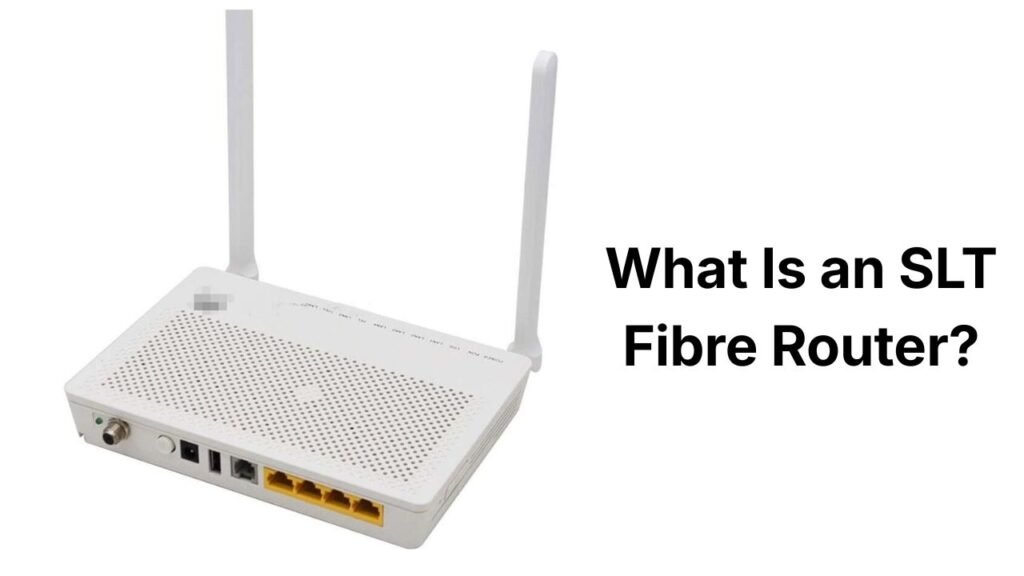
This makes fibre particularly attractive for households that need consistent performance.
SLT-MOBITEL’s current Fibre packages include plans such as Fibre Starter, Unlimited Home, Unlimited Home Plus and Unlimited Twin. The listed plans include speeds ranging from 100 Mbps connections to higher-speed options, depending on the package.
A major advantage of fibre is that its performance isn’t primarily determined by the strength of a mobile signal inside your house.
For example, if your family has several people watching YouTube, attending Zoom meetings, downloading files and browsing social media at the same time, fibre can be a strong choice.
How Fibre Internet Reaches Your Home
The basic connection works like this:
SLT fibre network → fibre cable → ONT/router → Wi-Fi devices
The fibre cable carries the internet connection into your premises. The router or Wi-Fi equipment then distributes that connection to phones, laptops, smart TVs, gaming consoles and other devices.
This is fundamentally different from a 4G router, which communicates wirelessly with an SLT mobile network tower.
Fibre Speed Advantages
One of the biggest reasons people choose fibre is speed.
SLT-MOBITEL currently lists Fibre plans with download speeds such as 100 Mbps and 200 Mbps, while some higher-end Fibre offerings reach substantially greater speeds. The provider also lists 1 Gbps Fibre technology for selected connections.
For an ordinary household, you don’t necessarily need the fastest plan available. However, having additional bandwidth can become useful when multiple people use the connection simultaneously.
What Is an SLT 4G Router?
An SLT 4G router provides home broadband through the 4G/LTE network. Instead of requiring a fibre cable to your property, the router communicates with the cellular network.
Think of it as turning a mobile broadband connection into a Wi-Fi network for your home.
This can be particularly useful in areas where Fibre isn’t available.
SLT-MOBITEL offers fixed 4G/LTE broadband packages, including volume-based packages and unlimited options. Its current package listings include 4G options such as 50GB, 85GB, 115GB and 200GB plans, as well as unlimited packages with speed tiers.
How a 4G Router Works
The connection generally follows this path:
SLT 4G tower → LTE wireless signal → 4G router → Wi-Fi devices
The router’s location can therefore make a noticeable difference.
If your router receives a strong and stable LTE signal, your internet experience can be good. If the signal is weak, congested or unstable, performance can suffer.
That’s one of the biggest differences you’ll notice when comparing an SLT Fibre Router vs 4G Router Packages.
SLT Fibre Router vs 4G Router: Quick Comparison
| Feature | SLT Fibre | SLT 4G/LTE |
|---|---|---|
| Connection type | Fibre-optic cable | Mobile LTE network |
| Typical stability | Very high | Depends on signal/network |
| Speed consistency | Generally more consistent | Can fluctuate |
| Installation | Requires fibre availability | Does not require fibre line |
| Mobility | Fixed location | Router remains fixed, but uses mobile network |
| Gaming | Excellent for most users | Can be suitable, depending on latency |
| Streaming | Excellent | Good with suitable package |
| Multiple users | Better for heavy households | Depends on signal and package |
| Coverage | Only where Fibre is available | Depends on 4G coverage |
| Signal dependency | Low | High |
| Best for | Heavy home users | Homes without Fibre |
| Main advantage | Performance and consistency | Availability and flexibility |
Speed: Which One Is Faster?
When it comes to raw speed, Fibre generally has the advantage.
SLT-MOBITEL currently lists Fibre plans with speeds including 100 Mbps, 200 Mbps and higher-speed Fibre offerings. Its package information also identifies 1 Gbps Fibre technology for selected plans.
SLT’s 4G packages can also provide useful speeds. However, the actual performance depends heavily on network conditions, signal strength, tower capacity and other factors.
A 4G connection might perform very well during one period and slow down during another.
That’s because you’re sharing wireless network resources with other users in the surrounding area.
Upload Speed Matters Too
Many people only look at download speed, but upload speed is important for:
- Zoom meetings
- Google Meet
- Uploading videos
- Cloud backups
- Sending large files
- Live streaming
- Remote work
- Online content creation
Fibre generally provides a more predictable upload experience than mobile broadband.
If you regularly upload large files or work with cloud services, Fibre is usually the safer choice.
Reliability: Which Connection Is More Stable?
Reliability is one of the strongest reasons to consider Fibre.
Because Fibre uses a physical connection, it isn’t affected by mobile signal strength in the same way that 4G is.
A 4G router can be affected by:
- Distance from the tower
- Indoor signal strength
- Building materials
- Network congestion
- Weather-related conditions
- Tower capacity
- Router placement
- Local network demand
That doesn’t mean 4G is unreliable. In many areas, it can work extremely well.
However, the important point is that your experience can vary more.
If your household depends heavily on the internet for work, school or business, consistent performance may be more valuable than simply having an available connection.
SLT Package Options: Fibre vs 4G
SLT-MOBITEL’s current broadband listings provide a useful example of the difference between the two technologies.
For Fibre, the provider currently lists packages such as:
- Fibre Starter with 80GB anytime data
- Unlimited Home
- Unlimited Home Plus
- Unlimited Twin
- Higher-speed Fibre offerings
The current package page lists Fibre Starter at up to 100 Mbps download and 50 Mbps upload, while some unlimited Fibre packages provide higher speeds.
For 4G, the listed options include:
- HBB Anytime 50GB
- HBB Anytime 85GB
- HBB Anytime 115GB
- HBB Anytime 200GB
- LTE Flash 5
- LTE Flash 10
- LTE Unlimited 2
- LTE Unlimited 4
- LTE Unlimited 8
For example, the current SLT listing shows LTE Unlimited 2 at up to 2 Mbps, LTE Unlimited 4 at up to 4 Mbps and LTE Unlimited 8 at up to 8 Mbps.
Important: Broadband prices, packages, taxes, speeds, terms and availability can change. Always verify the latest information directly with SLT-MOBITEL before purchasing.
Check the latest SLT-MOBITEL broadband packages
Which Is Better for Gaming?
If gaming is important to you, Fibre is generally the better choice.
Online gaming doesn’t require enormous download speeds. Instead, players care about:
- Low latency
- Stable ping
- Minimal packet loss
- Consistent connection quality
A 4G connection can still be perfectly usable for gaming, especially if you have a strong signal and low congestion.
However, mobile network conditions can change.
For competitive games such as first-person shooters, racing games and other real-time multiplayer titles, consistency matters more than having a huge download number.
If your priority is serious online gaming, Fibre should normally be your first choice when it’s available.
Which Is Better for Netflix and YouTube?
Both Fibre and 4G can support video streaming.
For a single user watching standard-definition or high-definition video, a suitable 4G package may be enough.
However, the situation changes when several people stream simultaneously.
Imagine a household where:
- One person watches Netflix.
- Another watches YouTube.
- A child attends an online class.
- Someone downloads a large game.
- Another person joins a video meeting.
That’s where Fibre starts to make more sense.
Its greater capacity and more consistent connection can help reduce the chances of buffering and slowdowns.
Which Is Better for Work From Home?
For remote workers, Fibre is usually the stronger long-term option.
Working from home often involves more than simply browsing websites.
You may need to use:
- Microsoft Teams
- Zoom
- Google Meet
- Cloud storage
- Remote desktop applications
- VPN services
- Online project management tools
- Large document transfers
SLT’s 4G Flash packages, for example, are designed around access to selected collaboration and e-learning platforms at standard LTE speed. The current package terms mention services such as Zoom, Microsoft Teams, Office 365, Cisco Webex, Skype and Google Meet.
Still, if you need broad, consistent connectivity for many different applications, Fibre is usually preferable.
Which Is Better for a Large Family?
For a large household, Fibre generally wins.
The reason is simple: multiple devices compete for bandwidth.
A family of four or five may have:
- Multiple smartphones
- Several laptops
- Smart TVs
- Tablets
- Gaming consoles
- Security cameras
- Smart home devices
A 4G connection may handle this load if the package and network are strong enough.
But if everyone uses the internet heavily at the same time, Fibre gives you more room to breathe.
Installation and Availability
This is where 4G has a major advantage.
Fibre requires physical infrastructure to reach your property.
If SLT Fibre isn’t available in your area, you can’t simply buy a Fibre router and create a Fibre connection yourself.
4G is different.
If fixed 4G/LTE service is available in your location and the network provides adequate signal quality, you can use a compatible SLT 4G router.
SLT’s official new-connection information lists different 4G router charges depending on the connection and equipment option. It currently includes new and refurbished router options, with conditions such as commitment periods applying to certain concessionary router arrangements.
This makes 4G particularly attractive for:
- Rural homes
- Temporary accommodation
- Rental properties
- Locations without Fibre
- Users who want a simpler broadband setup
Initial Router and Connection Costs
Don’t compare only the monthly rental.
You should also consider:
- Router cost
- Installation or connection charge
- Monthly rental
- Government taxes
- Data limits
- Add-on costs
- Contract or commitment conditions
SLT’s current Fibre connection information lists connection charges for Fibre installations and Fibre ONT equipment, while 4G connection information lists different router fees depending on the selected option.
The cheapest-looking monthly plan isn’t always the cheapest overall option.
For example, if you regularly purchase extra data, a higher monthly package may actually provide better value.
Data Limits: An Important Difference
Before choosing a package, calculate your monthly data usage.
A household that mostly browses websites and checks email may use relatively little data.
A household that streams video every day can use much more.
You should pay special attention to whether a package is:
- Volume-based
- Anytime data
- Unlimited
- Speed-limited unlimited
- Time-based
- Subject to fair-use or package-specific conditions
SLT’s current package terms show that some Fibre and 4G options have different rules for unlimited access, additional data and speed limitations.
For example, an “unlimited” package doesn’t necessarily mean unlimited maximum-speed internet in every situation. Always read the specific package conditions before signing up.
What About 4G Router Signal Strength?
If you’re considering an SLT 4G router, signal strength should be one of your first checks.
Router placement can make a surprisingly big difference.
Try placing the router:
- Near a window
- In a higher location
- Away from thick concrete walls
- Away from large electrical equipment
- In the part of the house with the strongest signal
Some users may also benefit from testing different locations before deciding where to permanently install the router.
If the 4G signal is weak, a high-priced package won’t magically fix the underlying signal problem.
When Should You Choose SLT Fibre?
Fibre is the better choice if:
- Fibre is available at your address.
- You need stable internet.
- Several people use the connection.
- You work from home.
- You frequently stream HD or 4K content.
- You play online games.
- You upload large files.
- You use cloud services heavily.
- You want a long-term home broadband solution.
For a typical family home with heavy internet usage, Fibre is usually the more future-ready option.
When Should You Choose an SLT 4G Router?
A 4G router can be the smarter choice if:
- Fibre isn’t available.
- You live in a location with good SLT 4G coverage.
- You need internet quickly.
- You rent your home.
- You don’t want a physical fibre installation.
- Your internet usage is moderate.
- You need a backup internet connection.
- Your household doesn’t require high upload speeds.
In other words, don’t automatically dismiss 4G.
If the signal at your home is excellent and your usage is moderate, an SLT 4G package can provide a practical internet solution.
7 Factors to Check Before Buying
Before making your final decision, consider these seven factors.
1. Fibre Availability
First, find out whether SLT Fibre is available at your address.
If it isn’t, your choice may already be clear.
2. Number of Users
One person using the internet casually has very different requirements from a family of five.
3. Monthly Data Usage
Estimate how much data you use for streaming, downloads, updates and work.
4. Gaming and Video Calls
If low latency and stable performance matter, Fibre usually has the advantage.
5. Upload Requirements
Content creators, remote workers and businesses may need better upload performance.
6. Budget
Look beyond the advertised monthly rental. Consider router and connection charges as well.
7. Network Signal
For 4G, test the actual signal at your home rather than assuming that coverage on a map guarantees excellent indoor performance.
SLT Fibre vs 4G: Which One Should You Buy?
If both options are available at your home, I’d generally recommend SLT Fibre for most heavy home users.
Fibre offers a more consistent connection, higher potential speeds and better performance for multiple simultaneous users.
However, 4G can be the better choice when Fibre isn’t available or when you need a convenient broadband connection without a fibre installation.
Here’s a simple decision guide:
| Your Situation | Recommended Option |
|---|---|
| Heavy family internet use | Fibre |
| Online gaming | Fibre |
| Work from home | Fibre |
| Frequent 4K streaming | Fibre |
| Large downloads | Fibre |
| Multiple users | Fibre |
| Fibre unavailable | 4G |
| Rental property | 4G |
| Moderate internet usage | 4G can be suitable |
| Strong 4G signal but no Fibre | 4G |
| Need a backup connection | 4G |
| Want maximum consistency | Fibre |
Ultimately, the best SLT Fibre Router vs 4G Router Packages choice isn’t simply about the cheapest package or the highest advertised speed.
It’s about matching the technology to your household.
Frequently Asked Questions
Let’s find some FAQ for this topic.
Is SLT Fibre better than an SLT 4G router?
For most heavy home users, yes. Fibre generally provides more consistent speeds and lower latency, while 4G performance depends more heavily on signal quality and network congestion.
Can SLT 4G be good enough for a family?
Yes. If your home has strong 4G coverage and the package provides enough data and speed, 4G can work well for a family. However, Fibre is generally better for households with several heavy users.
Is Fibre faster than 4G?
Generally, Fibre offers higher and more consistent speeds. SLT’s current package listings include Fibre plans at 100 Mbps and above, while its 4G unlimited plans include speed tiers such as up to 2 Mbps, 4 Mbps and 8 Mbps.
Is an SLT 4G router good for gaming?
It can be, especially with a strong signal and low network congestion. However, Fibre is generally preferable for competitive gaming because connection stability and latency are important.
Can I use an SLT 4G router if Fibre isn’t available?
Yes, fixed 4G/LTE broadband is specifically useful in locations where a Fibre connection isn’t available, provided suitable SLT 4G/LTE service is available at your location.
Which is better for Netflix: Fibre or 4G?
Both can support Netflix, but Fibre is generally better for households where several devices stream simultaneously.
Does a more expensive 4G package guarantee faster internet?
No. A package can provide a higher allowance or speed tier, but actual 4G performance can still depend on signal quality, network congestion, router placement and local network conditions.
Should I buy Fibre if I only use the internet occasionally?
Not necessarily. If your usage is light and Fibre isn’t essential for your needs, a suitable 4G package may provide better value and convenience.
Final Verdict
When comparing SLT Fibre Router vs 4G Router Packages, there isn’t one universal answer for every household.
If Fibre is available and you want reliable, high-performance home internet, SLT Fibre is generally the better long-term choice. It’s particularly suitable for families, gamers, remote workers, streamers and households with many connected devices.
If Fibre isn’t available, or you want a simpler broadband solution, SLT 4G/LTE can be an excellent alternative. A strong local 4G signal combined with an appropriate package can provide a practical home internet connection.
Before buying, check the latest SLT-MOBITEL package prices, speeds, taxes, router charges, data allowances and terms. Package details can change, so the provider’s official information should always be your final reference.
The simplest rule is this:
Choose Fibre for performance and consistency. Choose 4G for availability and flexibility.
That one distinction will help most Sri Lankan households make the right decision.